Well, I've taken the plunge and have been consolidating my weblogs, web presence, etc... so I have rolled over my Blogger blog to edublogs.org.
My edublogs weblog is Ed(ge)ucation design: learning about design...from experience
Please update your feed to: http://edge.edublogs.org/feed/
Blogger has served me very well since I started blogging in 2003, but I've been loathe to go to the new blogger version since Google have taken over (I am a Google user in many respects too), and I want to support the great service James has provided via edublogs. Plus, I have a bit more to learn on WordPress and I certainly wish to keep on learning! :o)
Tuesday, January 09, 2007


Friday, January 05, 2007
Do you have a project for 2007?
If not, then you might like to read Marica's post about Project 365 - it's a project where you take a photo per day and blog it as a visual diary for the year. It's a lovely way to focus your blogging I bet and, judging from Marica's first few days, seems quite effective too!
I had started Freire Fridays partly for the purpose of focusing my blogging and making sure I posted at least once during the week. It worked for a while (and I'll admit that I've sifted through Pedagogy of the Oppressed enough times to now find I'm repeating myself with quotes! I found it rather an interesting way to actually read the book too :o) - and the process was focused AND fun to do too! I did revisit Freire more recently...
If you're not sure why you're blogging or what you should be blogging about, perhaps starting your own project could be a starting point?
Thanks for sharing your project with us Marica! I'll look forward to reading your project and watching it develop over the year (and of course...no pressure!) :o)
technorati tags:project, photos, diary, 365, 2007
Blogged with Flock
Wednesday, January 03, 2007
miniSeries: movies for your mobile

miniSeries: Episodic adventures for mobile phones
The ABC have pulled together some wonderful little movies that are mobile-sized! It costs you to download them to your phone, but you can preview them (in full) online as well. These movies would be good little tasters for your students, especially those studying communications, arts, moving imagery and so on, not to mention potential cross-subject activities!
The Perils of Flossy held my attention well - loved the combination of music with the visuals. Each episode is quite short (say, a couple of minutes, making downloading to your phone easier, and hopefully cheaper?). Each episode links well in true series fashion. This illustrates how series are constructed too - as viewed on television for example; that is, they consist of relevant narrative links from one episode to the next, along with overarching themes and strong characters, yet have an immediate impact, narratively speaking, within each episode.
Very nice learning tools in themselves, these little movies, as well as telling a good story!
Well done to the movie makers, the ABC and their miniSeries partners m.Net, South Aust Film Corporation and The Aust Network for Art and Technology (ANAT) for making these available.
technorati tags:mobile, movies, ABC, mini-series, filmmaking, mobilephone
Blogged with Flock
New Year resolutions for teaching and learning
I don't normally contend with new year's resolutions, but for some reason talk about resolutions insists on wandering into my arc of hearing :o)
I've listened to some comments on the local radio and have skipped through articles that share new year's resolutions, most of which are the standard... lose weight, be happier, don't smoke, etc (not that these aren't admirable of course!) ... even gardening!

I thought to myself, "self, what about some resolutions to do with teaching and learning for 2007?" "What about them?" I replied, "I feel I have yet to resolve 2006!!"
So, here is my list of aspects of teaching and learning I will resolve to engage in over 2007 (and perhaps I'll be back to this list January 3rd 2008 to see how I did!):
[2007], [new year], [resolutions], [lists]
I've listened to some comments on the local radio and have skipped through articles that share new year's resolutions, most of which are the standard... lose weight, be happier, don't smoke, etc (not that these aren't admirable of course!) ... even gardening!

I thought to myself, "self, what about some resolutions to do with teaching and learning for 2007?" "What about them?" I replied, "I feel I have yet to resolve 2006!!"
So, here is my list of aspects of teaching and learning I will resolve to engage in over 2007 (and perhaps I'll be back to this list January 3rd 2008 to see how I did!):
- see things through (learn from the past but don't stay there)
- less is more (don't get carried away)
- think out aloud (others can hear you more clearly!)
- if all else fails, learn from it (failure is good m-key!)
- do something that alters the status quo (for me and for learners!)
- tell (and listen to) stories about learning that are good and not-so-good
- make room for the difficult questions (goes well with 'less is more'!)
[2007], [new year], [resolutions], [lists]
Thursday, December 07, 2006
Who's learning about e-learning from whom? (ASCILITE 2006 paper)
As promised, our short presentation on DELTA. View this Flickr set as a slideshow. I've also included notes in the description of each slide, to give it context. You can access our paper online from the ASCILITE website. Other papers are here.
Enjoy!

Enjoy!
Wednesday, December 06, 2006
Reflection on ASCILITE conference themes (DAY 2)
Gabcast! On the Move #3
- How do we define our educational design and taxonomies within educational design?
- Why are we not challenging what e-learning actually means and the e-learning created currently? Are we critiquing the work we do and the work of our colleagues sufficiently?
- Where are the students and the student 'voice'?
Listen to hear more of my reflections so far from ASCILITE 2006 in Sydney. Add your comments and questions too if you like...!
- How do we define our educational design and taxonomies within educational design?
- Why are we not challenging what e-learning actually means and the e-learning created currently? Are we critiquing the work we do and the work of our colleagues sufficiently?
- Where are the students and the student 'voice'?
Listen to hear more of my reflections so far from ASCILITE 2006 in Sydney. Add your comments and questions too if you like...!
Tuesday, December 05, 2006
ASCILITE 2006 delta team reunited!
End of day one saw the DELTA (Designing Electronic Learning and Teaching Approaches) team reunited in a short presentation about the professional development experiences the DELTA development and evaluation supported.
It was a great experience to present with most of the team once again, and we ran the presentation as we might have one of our development meetings, where we could model the consensus approach we used to inform our decision making process and continue the development of DELTA. We presented in a 'round-robyn' format, highlighting key points from participatory action research that framed our process and also informed our evaluation module where we collected our own reflections about DELTA and aspects of its development. We used our reflections alongside the data collected from other sources.
More about the paper and presentation via the ASCILITE site, but I'll also upload the slides for viewing here shortly.
Thanks to Robyn, Gayani, Charlotte and Sintie for their work on the presentation (Sintie for taking some photos!) and for sharing their reflections as part of the presentation. It was a good chance to look back on the experience, given it is the 1st anniversary after our disbanding as a team from CeLTS (closed end of 2005).
If you are interested to know more about DELTA, it has been re-launched from the Faculty of Medicine, Nursing and Health Sciences at Monash University and you can contact either Robyn or Charlotte for more details there.
More on day two shortly!

It was a great experience to present with most of the team once again, and we ran the presentation as we might have one of our development meetings, where we could model the consensus approach we used to inform our decision making process and continue the development of DELTA. We presented in a 'round-robyn' format, highlighting key points from participatory action research that framed our process and also informed our evaluation module where we collected our own reflections about DELTA and aspects of its development. We used our reflections alongside the data collected from other sources.
More about the paper and presentation via the ASCILITE site, but I'll also upload the slides for viewing here shortly.
Thanks to Robyn, Gayani, Charlotte and Sintie for their work on the presentation (Sintie for taking some photos!) and for sharing their reflections as part of the presentation. It was a good chance to look back on the experience, given it is the 1st anniversary after our disbanding as a team from CeLTS (closed end of 2005).
If you are interested to know more about DELTA, it has been re-launched from the Faculty of Medicine, Nursing and Health Sciences at Monash University and you can contact either Robyn or Charlotte for more details there.
More on day two shortly!
Monday, December 04, 2006
Uni of Sydney preASCILITE 2006
Photo taken on Sunday, pre-ASCILITE conference at the beautiful grounds of Uni of Sydney, Camperdown.
Wonderful to meet up with colleagues from around Australia and New Zealand, to share work tips and news from 2006! It's a buzz so far and we're barely into day 1!
So far, the first session of papers has looked at the use of role plays face-to-face and web-based...plus some uses of modularised learning objects developed with open source intentions, reusability and customisation.
Our presentation is on this afternoon, we're presenting collaboratively to highlight the participatory conversational process we engaged in (at Monash Uni) when developing an e-learning resource to showcase electronic learning and teaching approaches from across the uni.
Some neat features on trial: sms voting for the posters, and a "Dob in the Yobbo" (if you're familair with the cricket set up for this season, where crowd members at the cricket can do just that, if they feel a person is not behaving in the crowd!), for papers that may not have the best 'theoretical underpinning' or the delivery is not focussed enough! All light-hearted intentions of course!
There is also an ASCILITE blog, so far managed by Margaret Maag and a podcasting site using edublogs. Get in and have a look - you'll hear from some of the presenters themselves, plus delegates feedback during the conference and reflections about the presentations and all to do with the theme, "who's learning? Whose technology?"
Ciao for now!

Wonderful to meet up with colleagues from around Australia and New Zealand, to share work tips and news from 2006! It's a buzz so far and we're barely into day 1!
So far, the first session of papers has looked at the use of role plays face-to-face and web-based...plus some uses of modularised learning objects developed with open source intentions, reusability and customisation.
Our presentation is on this afternoon, we're presenting collaboratively to highlight the participatory conversational process we engaged in (at Monash Uni) when developing an e-learning resource to showcase electronic learning and teaching approaches from across the uni.
Some neat features on trial: sms voting for the posters, and a "Dob in the Yobbo" (if you're familair with the cricket set up for this season, where crowd members at the cricket can do just that, if they feel a person is not behaving in the crowd!), for papers that may not have the best 'theoretical underpinning' or the delivery is not focussed enough! All light-hearted intentions of course!
There is also an ASCILITE blog, so far managed by Margaret Maag and a podcasting site using edublogs. Get in and have a look - you'll hear from some of the presenters themselves, plus delegates feedback during the conference and reflections about the presentations and all to do with the theme, "who's learning? Whose technology?"
Ciao for now!
Wednesday, November 29, 2006
Developing a mobile learning strategy?
Mark van 't Hooft at Mobile Learning Redefined « Ubiquitous Thoughts (via Leonard) points to some work by Mike Sharples and others re-examining mobile learning; what it means, what it requires and what strategies might be employed to develop mlearning approaches further.
I was drawn to the three foci quoted below outlined by van 't Hooft :
Mike Sharples wrote a nice piece about this in October 2005, entitled "Re-thinking learning for the mobile age." In it, he discusses three foci of the Kaleidoscope special interest group on the Philosophy of Technology Enhanced Learning:
1. distinguish what is special about learning in the mobile age compared to other types of learning activity.
2. a theory of mobile learning must embrace the considerable learning that occurs outside classrooms and lecture halls.
3. we must take account of the ubiquitous use.
These appear to me to be the overarching points with which to develop mobile learning strategies for organisations, communities, schools, networks and so on. These points allow us to critique our motives, structures and approaches to learning generally and our learners - as lifelong learners - more specifically.
How many organisations have a learning strategy, let alone a mobile learning strategy? What about a flexible learning plan? Or an elearning philosophy? What type of strategic plan does your organisation have?
....and this is fast becoming a mantra around my workplace: it is the learner who is mobile, not the technology!
technorati tags:mike.sharples, mlearning, learning, strategy, mobile, projects, sharples, mobile.learning
Blogged with Flock
Saturday, November 25, 2006
Group work: why not ask your students?
This via Stephen Downes...
Konrad has been reflecting on the use of group work after some feedback from teachers, parents and students at school.

Image: Lilia Efimova
English 8, 2006-07 » Group Work: Good or Bad? In this link you can read some points about the pros and cons of group work as year 8 students explain.
Some of the points from the students that stood out for me:
- maybe people just don?t like group work because they are not able to communicate and share their ideas with others.
- there is another type when you have to make sure that you have done something and try and trick others into showing that you have actually done something.
- if people are trained to put their brains together, to give different ideas, then a project could almost always go further.
- Group work will help people to cooperate with people you don?t like and it is very important because even when you go to work when you are old, you will still be doing group work all the time.
- My conclusion is not that group work is better than Individual work, but group work can teach students which can?t be taught by always working individually. i also agree on how Konrad Glogowski said about group works making the class noisy and de-concentrated.
Well-considered points don't you think? And these are just a few!
How do your students find group work? What dynamics stand out for you as a teacher or as a learner?
All this reminds me that we need to remain critically aware of the strategies we employ in our teaching and learning and not take things for granted - one size doesn't fit all!
technorati tags:groupwork, student.voices, konrad.glogowski
Blogged with Flock
Student voices: dealing with real issues

Reality Check - information on youth mental health
Here's a step in the right direction. Students helping themselves help each other. Found this in the weekend Canberra Times (25/11/2006, News p.13).
Students have helped develop a website exploring and exposing the ins and outs of body image.
Karin MacDonald, Brindbella MLA helped launch the website recently, along with editor of Lip Magazine, Rachel Funari.
"Media Check encourages youth to resist media hype by creating and publishing your own media messages relating to mental health and well being"
Just another positive of the read/write web wouldn't you think?
technorati tags:students, voices, media, web, learning, mental.health
Blogged with Flock
Friday, November 03, 2006
Movember - all for men's health

At the start of N(M)ovember guys register with a clean shaven face. The Movember participants known as Mo Bros then have the remainder of the month to grow and groom their moustache and along the way raise as much money and awareness about male health issues as possible.
Our FLS team are going to participate, starting with Col (onya Col!) - you can check out his mo log (blog) and if you feel the urge to sponsor ($$$) him for his mo-tastic efforts during the month of November, then please do!
Ladies, you can also participate - mo sistas are welcome and can raise awareness of mens health issues too! :o)
From the Movember site, here are the key men's health issues for Movember 2006:
Prostate Cancer in partnership with the Prostate Cancer Foundation of Australia (www.prostate.org.au) because every year in Australia 2,700 men die of prostate cancer - more than the number of women who die from breast cancer.
Male Depression in partnership with Beyond Blue (www.beyondblue.org.au) because one in six men suffer from depression at any given time but most don't seek help.
Testicular Cancer because it?s the second most common cancer in young men aged 18 to 35.
So, here's a new (follicle) challenge for you... If you feel the urge, join up yourself and invite your own sponsors for this great initiative!
Blogged with Flock
Thursday, October 26, 2006
Welcome to the News at Seven!
Quick one today (as I finish off an essay!)...
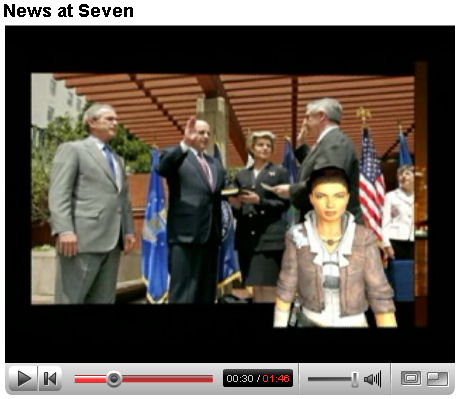
News at Seven is a neat way to present RSS news feeds audiovisually, which can also link to bloggers comments (in this example at least). This is a project from InfoLab, Northwestern University in the US.
And for learning? How about a student "newspaper" or student project updates, or learning activities in the workplace, as well as local community updates, beamed via internet and pulled down by users to their computers or mobile devices via RSS? Sounds pretty feasible to me! Could you see this audiovisual type of RSS applying to your teaching context?
This from the News at Seven project website:
More videos can be found here.News At Seven is a system that automatically generates a virtual news show. Totally autonomous, it collects, parses, edits and organizes news stories and then passes the formatted content to an artificial anchor for presentation. Using the resources present on the web, the system goes beyond the straight text of the news stories to also retrieve relevant images and blogs with commentary on the topics to be presented.
Friday, October 20, 2006
Freire Friday: Censorship, community, control and cat fights
One of the characteristics of oppressive cultural action which is almost never perceived by the dedicated but naive professionals who are involved is the emphasis on the focalized view of problems rather than on seeing them as dimensions of a totality.-- Paulo Freire, Pedagogy of the Oppressed (1972, p.111).
It was reported in the news earlier this week that YouTube contained numerous recordings from mobile phones of school fights. Adolescence psychologist, Dr Michael Carr-Gregg, slammed the service for allowing this type of stuff to be made widely available, citing that children should be protected from this type of voilence on YouTube, to avoid "copycat" behaviours, and that the service should be shut down, or at least blocked to young people by their parents.

Hmmm, sounds similar to the not-so-recent turkey-slapping episode on Big Brother (Australia) which saw two male contestants being booted out of the house for their actions towards a female participant, and parliamentarians, including PM John Howard, calling for the axing of the show.
Leigh Blackall raised the phone recording of school fighting phenomenon in his recent talk at the Global Summit 06, with the point that we are so wrapped up in the pervasiveness of the technology that we aren't seeing the fact that our schools are becoming increasingly dangerous places for our children - and it's the children who are capturing this evidence on behalf of their parents, teachers, prinicipals, members of parliament, social workers, counsellors, police officers, and our many other community support and advocacy networks.
So, what are they doing about it? Daming YouTube and side-stepping the real problems alive in our schools! Where's the critical and considered discussion about what is actually being recorded on these services and shows?

We are accepting of what appears on our TV screens of an evening too - this little beauty was captured from the TV show NCIS - some parallel huh?! It's like saying a gun is a 44 Magnum, not a shotgun and then paying no attention to the consequences of a shooting!
As Carmel Egan reports in The Age, these "trends" illustrate similar issues that are apparent in our society - our TV shows, movies, news, documentaries, YouTubes, Google Videos, BlipTVs, Bloggers, WordPresses, Odeos, and so on... are all representations of Self and Society. We reflect in our everyday the everyday actions and beings we are.
So, if we don't like what we're seeing, don't shoot the messenger - seek out the heart of the problem and make a choice to do something about it![schooling], [censorship], [schoolchildren], [control], [YouTube], [BigBrother], [Freire]
Thursday, October 19, 2006
Exploring the possibilities of weblogs
Gabcast! On the Move #2
This was an example phonecast to demonstrate both the capabilities of using weblogs with mobile devices and to illustrate the powerful sense of immediacy of the tools and the actions taken in using the tools.
This was an example phonecast to demonstrate both the capabilities of using weblogs with mobile devices and to illustrate the powerful sense of immediacy of the tools and the actions taken in using the tools.
Friday, October 13, 2006
Freire Fridays: leadership through dialogue
 The correct method for a revolutionary leadership to employ in the task of liberation is, ... not 'libertarian propaganda'. Nor can leadership merely 'implant' in the oppressed a belief in freedom, thus thinking to win their trust. The correct method lies in dialogue.
- Paulo Freire, Pedagogy of the Oppressed, 1971, p.42
Even the tiniest revolution makes a difference. It's communicating them for the benefit of others that's the challenge, as I see it. You may have seen many leadership styles in your time, across a number of institutions. In today's climate of economic 'rationalisation', we have seen some forms of leadership being brought into question by a range of stakeholders, especially in our education systems.
What is a good leader to you? I favour the leader who supports her staff in the background, who practices humility in the face of myriad pressures, and who has a strong sense of self to back not only her team but her own ways of doing and being; all the while sustaining an ongoing conversation with those she meets. How is dialogue a key factor for good leadership then?
Just some loose thoughts on this summery Friday evening...! :o)
Image by chook poo
Tuesday, October 10, 2006
WOW - art on your skin
I joined Lynsey for WOW, a spectacularly festive feast of fabric, faces, frenetic dancing feats and fancy facards! (Fffffhew!)
If you haven't yet travelled to New Zealand, Wellington especially, then this is the best excuse for a trip, if you ever needed one! I can't recommend this cultural event enough! :o)
We were even warmed up to the show by a WOW street parade and 12-foot-tall dancing butterflies!
This is a truly international event and a great cultural arts drawcard for NZ. Hats off to all involved, especially the amazingly talented designers - what vision!

If you haven't yet travelled to New Zealand, Wellington especially, then this is the best excuse for a trip, if you ever needed one! I can't recommend this cultural event enough! :o)
We were even warmed up to the show by a WOW street parade and 12-foot-tall dancing butterflies!
This is a truly international event and a great cultural arts drawcard for NZ. Hats off to all involved, especially the amazingly talented designers - what vision!
Haiku, mobile learning and the practice of writing
"Mmmm, you could create a form of mobile-audio Haiku though," continued that voice in my head.Long conversations
beside blooming irises -
joys of life on the road
Matsuo Basho
Seeking - Walking the streets (Sept 26th, 2006)
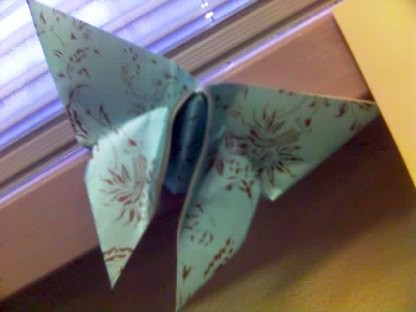
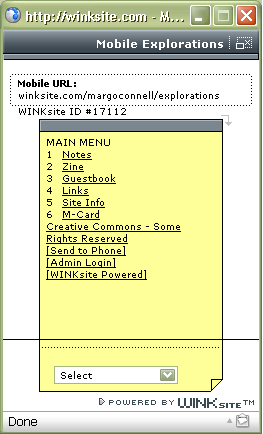
It seems easiest to liken haiku to a photograph, which captures a moment in time. A pure photograph describes a scene, and this description causes an emotional response in its viewer. There is no caption on the photograph that tells us what emotional response we are to take from it. It is instead a simple moment in time, unencumbered.Haiku is the same thing. When a butterfly lands upon an open flower, what does the haiku poet take from this? The same thing that his reader will take from it when he describes the moment in verse. But he trusts his reader to sense the same emotion from his accurate description of the scene. He does not need to say "How beautiful!" in reference to the moment, because his words should evoke the correct response in his reader.
I often have jottings and snippets or phrases dotted around my desk on sticky notes, or written messily into notebooks (like my A5 laptop for example!) - even noted quickly in my mobile phone - and these hold meaning for me in ways a well-structured sentence may not.
Thus, from little things big things grow, as they say!
I'll leave you with my try at a haiku:
Live out loud and soft:
Expect a newness within
Greet the world in song.
technorati tags:haiku, mobile, mlearning, seeking, marica.sevelj, winksite, writing, prose, poetry, learning, practice
Blogged with Flock
Monday, October 09, 2006
Saturday, October 07, 2006
Blended learning: an RSS metaphor
The only true voyage . . . would be not to visit strange lands but to possess other eyes, to see the universe through the eyes of another, of a hundred others, to see the hundred universes that each of them sees. ?Marcel Proust
Blended learning -- blended learning -- blended learning?
For so long now we've considered blended learning to be the most useful way to draw together online and face-to-face approaches. We've come to understand (or at least feel comfortable with) blended learning as it draws together people and resources in a range of settings and formats...but, have we really blended learning?
It seems much of our blended learning practices are about modes of delivery and formats of resources (see this example, by Namit Kishore, NIIT). Have we limited our view and potential to be able to really blend or hybridise learning opportunities? Where are the learners?

At the recent eFest conference in New Zealand, Diana Oblinger (Educause) presented a keynote speech about the changing face of learning that included - more than ever - informal learning and increased diversity of learners in increasingly blurred learning settings where work, study and life collide. Oblinger began her presentation with these words:
One student walks across campus listening to an iPod; another is engrossed in text messaging on her cell phone. During class, they're Googling, IMing and playing games?often at the same time. More likely to use the library as a gathering place than a resource, this is the Net Generation. They co-exist beside older students who are juggling work, childcare and eldercare. Do we understand our learners? What do their experiences, attitudes and expectations mean for educational institutions?
Indeed, are we listening to what we are seeing in our learners?
There are recent efforts by some educators to tackle aspects of blended learning, responding with more fluid and open learning designs and spaces for diverse learners' needs, that also value personalised learning approaches. I agree with Oliver and Trigwell (2005) that we need to "radically reconcieve" the phrase, and re-centre the learner as key to a blended learning philosophy, "by exploring change [and patterns of change?] from the perspective of the learner" (p.24).

We need to look at what is being blended and why, and I considered this while listening to Oblinger's keynote at eFest. I think blended learning must involve recognition of
- multiverses
- learning spaces (more commentary on learning space design here and here)
- diverse and differing values of people
- relinquishing the term 'roles' in favour of a less abstracted notion of being in the world.
Oblinger described a number of learning processes, concepts and settings that speak to a more enlightened view of blended learning. She described projects like the Learning Spaces Project at Denison University, as an illustration of practical aspects of blending learning that move beyond simply delivery considerations. The TLT Group also present some non-traditional ideas about the development of approaches and spaces that enable blended forms of learning. These forms recognise the value of
- communication and making connections with other people
- provide basic and necessary infrastructure to allow learning to occur
- share (increasingly scarce) resources appropriate to the learning taking place
- encourage learners to interact spontaneously
- draw on moments of serendipity
- allow facilitators to pick up on motivations of learners and tailor instruction/guidance as a result
- space becomes interactive, multi-sited, 'porous' and dynamic.
These days the Internet is our information universe, as Oblinger described it. For many, the Internet has become a personalised learning space; flexible, dynamic, fluid and connected.

(Image by Mobology)
In light of this, I liken a refreshed definition of blended learning to RSS. Stephen Downes (in his eFest keynote) described RSS as a 'mess' of technologies (of which there are a number of variations). We use RSS to 'pull' information and services to us to suit our individual needs and preferences. RSS is a good metaphor (as well as a technical tool) for understanding ways in which learners can pull together threads of learning to create a blended setting in which learning occurs - elements loosely joined. We could very well view learning as a 'pull' activity, dependent on the learner's preferences and needs at the time. A learner can 'RSS' types, formats, contacts (activities, networks, resources), blending their own learning environment.

Concluding questions...
As we continue to debate the future(s) of learning, Downes additionally challenges us with the notion of an alternative education system that is publicly funded and open to all, "that could be tapped into by traditional institutions, if they choose". Is it possible it could be something like this?
- An 'RSS-ed' view where the learner draws together threads/services (metaphorically and technically) to create their own learning space, complete with people, resources and contextualised information?
- Should we be thinking more about future scenarios that are set to challenge the relevance of our current systems?
- Do we attempt to eat our current systems from the inside-out OR must we take the party elsewhere?
- Should our institutions operate more like 'containers' for supporting learning spaces (through provision of infrastructure), motivated more by the learners' needs and less by curriculum?
- Will there come a day when we can say "ACME Institute works for me?"
- Will education return to being a (publicly-funded) service supporting people, instead of a business focused on 'user pays' and 'the bottom line'?
- How do we engage with the tensions of education in a networked society?
References
Downes, S. (2006) Keynote address, eFest 2006, September 27-29, Wellington, NZ.
Kishore, N. (2002) Blended learning - Fixing the mix, NIIT Technologies.
Oblinger, D. (2006) Keynote address, eFest 2006, September 27-29, Wellington, NZ.
Oliver, M. & Trigwell, K. (2005) Can 'blended learning' be redeemed? E-Learning, 2(1), 17-26.
Images by margoconnell, unless otherwise stated.[blended_learning], [open_education], [flnw], [oblinger], [downes], [efest_2006]
Subscribe to:
Posts (Atom)