Alexander Hayes captured a lot of the brainstorming we did about the interactive podcast idea. You can listen to a couple of podcasts we did to simulate how an interactive podcast might work, using Audacity.
At the end of the day I discussed the idea with Marica and Lynsey and lots of questions surfaced, mainly around the idea of rights of the originating 'author' and how some people may or may not be comfortable with the idea of having others 'annotate' their thoughts and writing (or audio) in this way.
These questions appear in the comments of the Flickr photo posted by mobology. The image is of my A5 "laptop" (and was very effective!).
Tuesday, October 03, 2006


Interactive podcasts - asynchronous audio activities?
Could we design "interactive" podcasts? This was an idea we explored in Wellington, New Zealand as part of the FLNW Open Conference. Check out this recording below.
interactive podcasts - blip.tv (beta) (thanks to Leigh for this recording).
I envisaged something like this because being a somewhat kinaesthetic learner, I like to 'do' as I listen and read things. So for me, being able to interrupt a conversation (or podcast) and make notes to prompt or clarify my own thinking, would be really useful and very timely. In most cases, I would do this manually anyway.
However, what if, when listening to a podcast, you were able to record your notes or questions or responses so that others could also listen to them along with the original podcast? You would effectively be adding your voice to the conversation! Really it could be called a conver-cast (emphasising the conversational element) and would occur in a 'layering of time'. The conversation occurs asynchronously and potentially combines
- discussion/chat
- podcasts
- commentary
- multiple voices
- remixing (perhaps copy and paste?)
- perhaps a wiki-like feature like rollback to previous versions (see comment by botheredByBees on BlipTV).
How might this be applied to learning situations?
I could imagine the 'lecture' for example, being podcasted, then students having the ability to zero in on a point being made, add a question, seek clarification, offer an opinion, and add to the 'lecture' in some way. This takes a linear 'one-way' resource and makes it inherently shareable, relevant to a learner's position of learning at a certain time. The podcast is recorded at one point in time, the learner's response may not take place until some time after (even after the course of study is finished). And it also allows for people to 'change their minds', as we often do in conversation where we can come around to another's point of view, for example.
Similarly, a facilitator could also present an 'unfinished' cast, where they begin a 'story' for example and invite learners to develop the cast over a period of time (like contributing to a wiki in a sense).
Exploring the possibilities...
What other situations might a conver-cast be effectively applied? What are the implications of such an approach? What other learning scenarios could be supported here?
I'd like to hear more from you - are their ramifications? Limitations? Other possibilities you see?
These are jsut some beginning thoughts...
technorati tags:podcasts, learning, flnw, wellington, newzealand, convercasting, conversation
Blogged with Flock
Saturday, September 30, 2006
Friday Sept 29: Farewell Wellington, NZ
In this audio post I recall my experiences in Wellington for the week, feeling that it's all gone too fast, but that I'm left with a sense of things just beginning.
Some key points I discuss in this post include:

Some key points I discuss in this post include:
- the torrent of visual metaphors for learning I see around me as I record this post,
- the possibilities for further conversations about developing networks and knowledge sharing, and
- generation 'I' and the need to pursue personalised learning in both informal and formal learning settings.
Thursday, September 28, 2006
Thursday Sept 28, Blogs and learning - a conversation (eFest 2006)
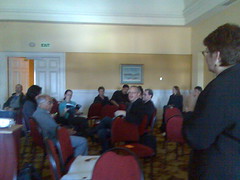 Thursday September 28, saw Marica and I run a conversation on 'blogs and learning' at eFest 2006, Wellington NZ. This audio post (below) explores our initial reactions and reflections about the session just after it had finished.
We set up the session details on this wiki page and have invited session participants to continue the conversation, to explore the idea of using blogs in learning settings. So, if YOU were there - we'd love to hear from you!
Also, if you'd like to run a session like this, we have included the activity structure on the wiki - you're welcome to use it. And we'd be interested to hear how your session goes! :o)
Some key points we shared immediately after the sessions included:
- the fact that people raised so many questions about ways of using blogs,
- that spam is unavoidable (our 'spammer' interrupted the session with flouro pink stick notes!), and
- that there is a need for some guidance for learners as to how effectively a blog can be used for learning.
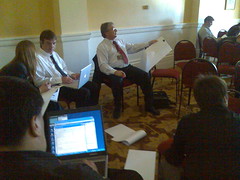 It's also quite a task to define what a blog is, because from the comments I heard from many of the participants who use blogs, they are as varied as the bloggers themselves! Another good call for personalised learning support methinks!
We will be updating the wiki page with some of the 'blog posts' people made, which highlight some of their initial thoughts related to Will Richardson's video on blogging in schools. Stay tuned!
Tuesday, September 26, 2006
Tuesday Sept 26: A cross-fertilisation of ideas (Open Polytechnic)
I recorded this short audio post with Marica, following dinner, reflecting on our day at the Open Polytechnic (Marcia's workplace and a distance education polytechnic based in Wellington).
I conducted a conversation at the Open Polytechnic about the current goings on in the Australian Flexible Learning scene and how it was preparing us for a future of learning. There was some exchange of ideas and experiences, some similar and some quite different. My wiki has a mash-up of presentation notes available.
Thanks to the Open Polytechnic staff for welcoming me into their workplace, and for sharing their experiences - in particular, Brent, Sue, Linda, Jerome, Judy, Anouk and Marica - I really appreciated it! I will be in touch with more questions shortly (especially about Moodle Linda!) :o)
I conducted a conversation at the Open Polytechnic about the current goings on in the Australian Flexible Learning scene and how it was preparing us for a future of learning. There was some exchange of ideas and experiences, some similar and some quite different. My wiki has a mash-up of presentation notes available.
Thanks to the Open Polytechnic staff for welcoming me into their workplace, and for sharing their experiences - in particular, Brent, Sue, Linda, Jerome, Judy, Anouk and Marica - I really appreciated it! I will be in touch with more questions shortly (especially about Moodle Linda!) :o)
Subscribe to:
Posts (Atom)