Gabcast! On the Move #1
Monday, October 09, 2006


Saturday, October 07, 2006
Blended learning: an RSS metaphor
The only true voyage . . . would be not to visit strange lands but to possess other eyes, to see the universe through the eyes of another, of a hundred others, to see the hundred universes that each of them sees. ?Marcel Proust
Blended learning -- blended learning -- blended learning?
For so long now we've considered blended learning to be the most useful way to draw together online and face-to-face approaches. We've come to understand (or at least feel comfortable with) blended learning as it draws together people and resources in a range of settings and formats...but, have we really blended learning?
It seems much of our blended learning practices are about modes of delivery and formats of resources (see this example, by Namit Kishore, NIIT). Have we limited our view and potential to be able to really blend or hybridise learning opportunities? Where are the learners?
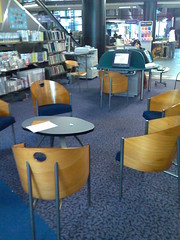
At the recent eFest conference in New Zealand, Diana Oblinger (Educause) presented a keynote speech about the changing face of learning that included - more than ever - informal learning and increased diversity of learners in increasingly blurred learning settings where work, study and life collide. Oblinger began her presentation with these words:
One student walks across campus listening to an iPod; another is engrossed in text messaging on her cell phone. During class, they're Googling, IMing and playing games?often at the same time. More likely to use the library as a gathering place than a resource, this is the Net Generation. They co-exist beside older students who are juggling work, childcare and eldercare. Do we understand our learners? What do their experiences, attitudes and expectations mean for educational institutions?
Indeed, are we listening to what we are seeing in our learners?
There are recent efforts by some educators to tackle aspects of blended learning, responding with more fluid and open learning designs and spaces for diverse learners' needs, that also value personalised learning approaches. I agree with Oliver and Trigwell (2005) that we need to "radically reconcieve" the phrase, and re-centre the learner as key to a blended learning philosophy, "by exploring change [and patterns of change?] from the perspective of the learner" (p.24).
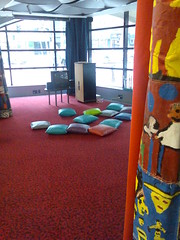
We need to look at what is being blended and why, and I considered this while listening to Oblinger's keynote at eFest. I think blended learning must involve recognition of
- multiverses
- learning spaces (more commentary on learning space design here and here)
- diverse and differing values of people
- relinquishing the term 'roles' in favour of a less abstracted notion of being in the world.
Oblinger described a number of learning processes, concepts and settings that speak to a more enlightened view of blended learning. She described projects like the Learning Spaces Project at Denison University, as an illustration of practical aspects of blending learning that move beyond simply delivery considerations. The TLT Group also present some non-traditional ideas about the development of approaches and spaces that enable blended forms of learning. These forms recognise the value of
- communication and making connections with other people
- provide basic and necessary infrastructure to allow learning to occur
- share (increasingly scarce) resources appropriate to the learning taking place
- encourage learners to interact spontaneously
- draw on moments of serendipity
- allow facilitators to pick up on motivations of learners and tailor instruction/guidance as a result
- space becomes interactive, multi-sited, 'porous' and dynamic.
These days the Internet is our information universe, as Oblinger described it. For many, the Internet has become a personalised learning space; flexible, dynamic, fluid and connected.

(Image by Mobology)
In light of this, I liken a refreshed definition of blended learning to RSS. Stephen Downes (in his eFest keynote) described RSS as a 'mess' of technologies (of which there are a number of variations). We use RSS to 'pull' information and services to us to suit our individual needs and preferences. RSS is a good metaphor (as well as a technical tool) for understanding ways in which learners can pull together threads of learning to create a blended setting in which learning occurs - elements loosely joined. We could very well view learning as a 'pull' activity, dependent on the learner's preferences and needs at the time. A learner can 'RSS' types, formats, contacts (activities, networks, resources), blending their own learning environment.
Concluding questions...
As we continue to debate the future(s) of learning, Downes additionally challenges us with the notion of an alternative education system that is publicly funded and open to all, "that could be tapped into by traditional institutions, if they choose". Is it possible it could be something like this?
- An 'RSS-ed' view where the learner draws together threads/services (metaphorically and technically) to create their own learning space, complete with people, resources and contextualised information?
- Should we be thinking more about future scenarios that are set to challenge the relevance of our current systems?
- Do we attempt to eat our current systems from the inside-out OR must we take the party elsewhere?
- Should our institutions operate more like 'containers' for supporting learning spaces (through provision of infrastructure), motivated more by the learners' needs and less by curriculum?
- Will there come a day when we can say "ACME Institute works for me?"
- Will education return to being a (publicly-funded) service supporting people, instead of a business focused on 'user pays' and 'the bottom line'?
- How do we engage with the tensions of education in a networked society?
References
Downes, S. (2006) Keynote address, eFest 2006, September 27-29, Wellington, NZ.
Kishore, N. (2002) Blended learning - Fixing the mix, NIIT Technologies.
Oblinger, D. (2006) Keynote address, eFest 2006, September 27-29, Wellington, NZ.
Oliver, M. & Trigwell, K. (2005) Can 'blended learning' be redeemed? E-Learning, 2(1), 17-26.
Images by margoconnell, unless otherwise stated.[blended_learning], [open_education], [flnw], [oblinger], [downes], [efest_2006]
Wednesday, October 04, 2006
OLT Conference 2006 : Learning on the Move
Whilst I was in New Zealand last week, my colleague Leonard attended the OLT Conference in Queensland, where he presented our paper, Learner-centric design of digital mobile learning.
We received the Best Paper Award! Thanks to the reviewers and the conference chairs for their support!

Other OLT2006 papers can be accessed here. I'd be interested to hear your thoughts about our paper ...Mobile Learning » Learner-Centric Design of Digital Mobile Learning
technorati tags:OLT, mlearning, conference, 2006, queensland, newzealand, award, paper
Blogged with Flock
Tuesday, October 03, 2006
Brainstorming the interactive podcasting idea
Alexander Hayes captured a lot of the brainstorming we did about the interactive podcast idea. You can listen to a couple of podcasts we did to simulate how an interactive podcast might work, using Audacity.
At the end of the day I discussed the idea with Marica and Lynsey and lots of questions surfaced, mainly around the idea of rights of the originating 'author' and how some people may or may not be comfortable with the idea of having others 'annotate' their thoughts and writing (or audio) in this way.
These questions appear in the comments of the Flickr photo posted by mobology. The image is of my A5 "laptop" (and was very effective!).

At the end of the day I discussed the idea with Marica and Lynsey and lots of questions surfaced, mainly around the idea of rights of the originating 'author' and how some people may or may not be comfortable with the idea of having others 'annotate' their thoughts and writing (or audio) in this way.
These questions appear in the comments of the Flickr photo posted by mobology. The image is of my A5 "laptop" (and was very effective!).
Interactive podcasts - asynchronous audio activities?
Could we design "interactive" podcasts? This was an idea we explored in Wellington, New Zealand as part of the FLNW Open Conference. Check out this recording below.
interactive podcasts - blip.tv (beta) (thanks to Leigh for this recording).
I envisaged something like this because being a somewhat kinaesthetic learner, I like to 'do' as I listen and read things. So for me, being able to interrupt a conversation (or podcast) and make notes to prompt or clarify my own thinking, would be really useful and very timely. In most cases, I would do this manually anyway.
However, what if, when listening to a podcast, you were able to record your notes or questions or responses so that others could also listen to them along with the original podcast? You would effectively be adding your voice to the conversation! Really it could be called a conver-cast (emphasising the conversational element) and would occur in a 'layering of time'. The conversation occurs asynchronously and potentially combines
- discussion/chat
- podcasts
- commentary
- multiple voices
- remixing (perhaps copy and paste?)
- perhaps a wiki-like feature like rollback to previous versions (see comment by botheredByBees on BlipTV).
How might this be applied to learning situations?
I could imagine the 'lecture' for example, being podcasted, then students having the ability to zero in on a point being made, add a question, seek clarification, offer an opinion, and add to the 'lecture' in some way. This takes a linear 'one-way' resource and makes it inherently shareable, relevant to a learner's position of learning at a certain time. The podcast is recorded at one point in time, the learner's response may not take place until some time after (even after the course of study is finished). And it also allows for people to 'change their minds', as we often do in conversation where we can come around to another's point of view, for example.
Similarly, a facilitator could also present an 'unfinished' cast, where they begin a 'story' for example and invite learners to develop the cast over a period of time (like contributing to a wiki in a sense).
Exploring the possibilities...
What other situations might a conver-cast be effectively applied? What are the implications of such an approach? What other learning scenarios could be supported here?
I'd like to hear more from you - are their ramifications? Limitations? Other possibilities you see?
These are jsut some beginning thoughts...
technorati tags:podcasts, learning, flnw, wellington, newzealand, convercasting, conversation
Blogged with Flock
Subscribe to:
Posts (Atom)