Friday, October 20, 2006

Freire Friday: Censorship, community, control and cat fights

One of the characteristics of oppressive cultural action which is almost never perceived by the dedicated but naive professionals who are involved is the emphasis on the focalized view of problems rather than on seeing them as dimensions of a totality.

-- Paulo Freire, Pedagogy of the Oppressed (1972, p.111).


It was reported in the news earlier this week that YouTube contained numerous recordings from mobile phones of school fights. Adolescence psychologist, Dr Michael Carr-Gregg, slammed the service for allowing this type of stuff to be made widely available, citing that children should be protected from this type of voilence on YouTube, to avoid "copycat" behaviours, and that the service should be shut down, or at least blocked to young people by their parents.
Hmmm, sounds similar to the not-so-recent turkey-slapping episode on Big Brother (Australia) which saw two male contestants being booted out of the house for their actions towards a female participant, and parliamentarians, including PM John Howard, calling for the axing of the show.

Leigh Blackall raised the phone recording of school fighting phenomenon in his recent talk at the Global Summit 06, with the point that we are so wrapped up in the pervasiveness of the technology that we aren't seeing the fact that our schools are becoming increasingly dangerous places for our children - and it's the children who are capturing this evidence on behalf of their parents, teachers, prinicipals, members of parliament, social workers, counsellors, police officers, and our many other community support and advocacy networks.

So, what are they doing about it? Daming YouTube and side-stepping the real problems alive in our schools! Where's the critical and considered discussion about what is actually being recorded on these services and shows?
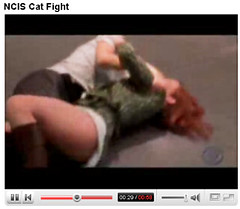

We are accepting of what appears on our TV screens of an evening too - this little beauty was captured from the TV show NCIS - some parallel huh?! It's like saying a gun is a 44 Magnum, not a shotgun and then paying no attention to the consequences of a shooting!

As Carmel Egan reports in The Age, these "trends" illustrate similar issues that are apparent in our society - our TV shows, movies, news, documentaries, YouTubes, Google Videos, BlipTVs, Bloggers, WordPresses, Odeos, and so on... are all representations of Self and Society. We reflect in our everyday the everyday actions and beings we are.

So, if we don't like what we're seeing, don't shoot the messenger - seek out the heart of the problem and make a choice to do something about it!


, , , , , ,

Thursday, October 19, 2006

Exploring the possibilities of weblogs

Gabcast! On the Move #2

This was an example phonecast to demonstrate both the capabilities of using weblogs with mobile devices and to illustrate the powerful sense of immediacy of the tools and the actions taken in using the tools.

Friday, October 13, 2006

Freire Fridays: leadership through dialogue

The correct method for a revolutionary leadership to employ in the task of liberation is, ... not 'libertarian propaganda'. Nor can leadership merely 'implant' in the oppressed a belief in freedom, thus thinking to win their trust. The correct method lies in dialogue.

- Paulo Freire, Pedagogy of the Oppressed, 1971, p.42


Even the tiniest revolution makes a difference. It's communicating them for the benefit of others that's the challenge, as I see it. You may have seen many leadership styles in your time, across a number of institutions. In today's climate of economic 'rationalisation', we have seen some forms of leadership being brought into question by a range of stakeholders, especially in our education systems.

What is a good leader to you? I favour the leader who supports her staff in the background, who practices humility in the face of myriad pressures, and who has a strong sense of self to back not only her team but her own ways of doing and being; all the while sustaining an ongoing conversation with those she meets. How is dialogue a key factor for good leadership then?

Just some loose thoughts on this summery Friday evening...! :o)

Image by chook poo

Tuesday, October 10, 2006

WOW - art on your skin


WOW program
Originally uploaded by margoc.
I joined Lynsey for WOW, a spectacularly festive feast of fabric, faces, frenetic dancing feats and fancy facards! (Fffffhew!)

If you haven't yet travelled to New Zealand, Wellington especially, then this is the best excuse for a trip, if you ever needed one! I can't recommend this cultural event enough! :o)

We were even warmed up to the show by a WOW street parade and 12-foot-tall dancing butterflies!


This is a truly international event and a great cultural arts drawcard for NZ. Hats off to all involved, especially the amazingly talented designers - what vision!

Haiku, mobile learning and the practice of writing

"Mmmm, you could create a form of mobile-audio Haiku though," continued that voice in my head.

Long conversations
beside blooming irises -
joys of life on the road
Matsuo Basho

Seeking - Walking the streets (Sept 26th, 2006)

Marica at Seeking reflects on the use of audioblogging, after my spending time in Wellington with her and her colleagues at the Open Polytechnic of NZ. I was particularly drawn to her thoughts about the Haiku and how a short piece of writing can convey much (in a similar way to an image that speaks a thousand words I suppose).

The haiku is a great metaphor for mobile learning, in that much is captured in a small 'space'. I have set up a Winksite called Mobile Explorations (for access via your mobile device, go to http://winksite.com and enter site ID # 17112) to capture these smaller moments that can be viewed and interacted with via a mobile device. Still in 'testing' phase, I have added a couple of haikus to the Zine, titled 'Haiku thinking'. You can add your own haikus via the Guestbook if you wish. Here's how it looks:

How can this be developed as a useful learning venture? Playful jottings and a few meaningful words can capture much of the essence of an experience in the same way images often do. It can enable the writer to develop ways of writing that convey a meaning or sense of an experience, just as we might interpret an image, its meaning, representation and structures, according to our position and frame of mind in time and space. Wu and Bergstraum describe this as the haiku moment:
It seems easiest to liken haiku to a photograph, which captures a moment in time. A pure photograph describes a scene, and this description causes an emotional response in its viewer. There is no caption on the photograph that tells us what emotional response we are to take from it. It is instead a simple moment in time, unencumbered.

Haiku is the same thing. When a butterfly lands upon an open flower, what does the haiku poet take from this? The same thing that his reader will take from it when he describes the moment in verse. But he trusts his reader to sense the same emotion from his accurate description of the scene. He does not need to say "How beautiful!" in reference to the moment, because his words should evoke the correct response in his reader.

I often have jottings and snippets or phrases dotted around my desk on sticky notes, or written messily into notebooks (like my A5 laptop for example!) - even noted quickly in my mobile phone - and these hold meaning for me in ways a well-structured sentence may not.

Thus, from little things big things grow, as they say!

I'll leave you with my try at a haiku:

Live out loud and soft:

Expect a newness within

Greet the world in song.

technorati tags:, , , , , , , , , ,

Blogged with Flock